Make Adorable Marta: Easy Knitted Sheep Pattern
Get ready to create the cutest little sheep with this easy-to-follow knitting pattern! Marta the Sheep stands about 10 cm tall and is perfect for snuggling or as a charming decoration. We’ll guide you through each step, from casting on to adding the finishing touches.
Materials You’ll Need:
- **Cream Boucle or Plush Yarn:** A small amount (approx. 250m/100g). For example, Alize SOFTY (115m/50g, 100% micro-polyester).
- **Brown Smooth Yarn:** A small amount (approx. 300m/100g with wool content) – about 30g. For example, Pekhorka “Magnificent” (30% angora, 70% high-volume acrylic).
- **Double-pointed Needles:** Size № 2.5 (a set of 4 or 5).
- **Stuffing Material:** Polyfill or similar toy stuffing.
- **Stitch Marker.**
- **Tapestry Needle:** For seaming and weaving in ends.
- **Black Embroidery Floss:** 6 strands for eyes.
Important Notes Before You Begin:
- **Size:** Your finished sheep will be approximately 10 cm (about 4 inches) in height.
- **Knitting Method:** The head and body are knitted in the round on three double-pointed needles, with the fourth needle used for working stitches. Ears, legs, and the tail are knitted flat on two needles.
- **Yarn Choice:** The original pattern emphasizes paying attention to yarn texture. The combination of plush/boucle for the body and smooth yarn for the face and limbs creates a lovely contrast.
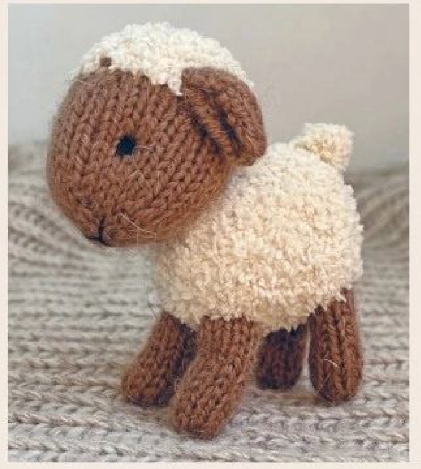
Your adorable finished Sheep Marta!
HEAD
We’ll knit the head in the round, starting from the nose.
Part 1: Brown Yarn Section
- **Cast On:** Using your brown yarn, cast on 6 stitches. Distribute these 6 stitches evenly onto 3 of your double-pointed needles (2 stitches on each needle).
- **Row 1:** Knit all 6 stitches.
- **Row 2 (Increase):** Knit into the front and back of each stitch (inc) 6 times. You will now have 12 stitches.
- **Row 3 (Increase):** (Knit 1 stitch, increase in the next stitch) repeat this sequence 6 times. You will now have 18 stitches.
- **Row 4 (Increase):** (Knit 2 stitches, increase in the next stitch) repeat this sequence 6 times. You will now have 24 stitches.
- **Row 5 (Increase):** (Knit 3 stitches, increase in the next stitch) repeat this sequence 6 times. You will now have 30 stitches.
- **Mark Beginning:** Place a stitch marker to clearly indicate the beginning of your row.
- **Rows 6-14 (Knit Straight):** Knit all 30 stitches. (This is 9 rows of plain knitting).
- **Close Initial Opening:** Carefully use your tapestry needle to tighten and close the small opening at the very beginning of your cast-on stitches. Weave in any remaining yarn tail to hide it inside the head.
- **Row 15 (Decrease):** (Knit 3 stitches, knit 2 stitches together – k2tog) repeat this sequence 6 times. You will now have 24 stitches.
- **Change Yarn:** Cut the brown yarn, leaving a short tail to weave in later. Attach your white plush yarn.
Part 2: White Plush Yarn Section
- **Row 16 (Increase):** (Knit 3 stitches, increase in the next stitch) repeat this sequence 6 times. You will now have 30 stitches.
- **Rows 17-21 (Knit Straight):** Knit all 30 stitches. (This is 5 rows of plain knitting).
- **Row 22 (Decrease):** (Knit 3 stitches, k2tog) repeat this sequence 6 times. You will now have 24 stitches.
- **Row 23 (Decrease):** (Knit 2 stitches, k2tog) repeat this sequence 6 times. You will now have 18 stitches.
- **Row 24 (Decrease):** (Knit 1 stitch, k2tog) repeat this sequence 6 times. You will now have 12 stitches.
- **Stuff the Head:** Firmly stuff the head with your chosen filler material, shaping it as you go.
- **Row 25 (Decrease):** Knit 2 stitches together (k2tog) 6 times. You will now have 6 stitches.
- **Finish Off:** Cut the yarn, leaving a tail of about 6 inches. Thread this tail onto your tapestry needle and carefully pull it through the remaining 6 stitches, then pull tight to completely close the opening. Secure with a knot and weave in the yarn end to hide it inside the head.
Photo 1: How to close the top of the head.
BODY
Knit with white plush yarn, in the round.
- **Cast On:** Cast on 6 stitches and distribute them onto 3 double-pointed needles (2 stitches per needle).
- **Row 1:** Knit all 6 stitches.
- **Row 2 (Increase):** Increase in each stitch 6 times. You will now have 12 stitches.
- **Row 3 (Increase):** (Knit 1, increase in next stitch) repeat 6 times. You will now have 18 stitches.
- **Row 4 (Increase):** (Knit 2, increase in next stitch) repeat 6 times. You will now have 24 stitches.
- **Mark Beginning:** Place a stitch marker to indicate the start of the row.
- **Rows 5-15 (Knit Straight):** Knit all 24 stitches. (This is 11 rows of plain knitting).
- **Row 16 (Shaping for Tail/Legs):** Knit 4, increase, knit 1, increase, knit 1. **Place a new stitch marker here** – this marks the center of the back and will help with tail and leg placement later. Continue: knit 1, increase, knit 1, increase, knit 12. You will now have 28 stitches.
- **Row 17 (Increase):** Knit 8, increase, knit 2, increase, knit 16. You will now have 30 stitches.
- **Optional:** For easier handling, you can redistribute your stitches so you have 10 stitches on each of your 3 needles.
- **Rows 18-21 (Knit Straight):** Knit all 30 stitches. (This is 4 rows of plain knitting).
- **Row 22 (Decrease):** (Knit 3, k2tog) repeat 6 times. You will now have 24 stitches.
- **Row 23 (Decrease):** (Knit 2, k2tog) repeat 6 times. You will now have 18 stitches.
- **Row 24 (Decrease):** (Knit 1, k2tog) repeat 6 times. You will now have 12 stitches.
- **Stuff the Body:** Firmly stuff the body with filler, shaping it as you go.
- **Row 25 (Decrease):** Knit 2 stitches together (k2tog) 6 times. You will now have 6 stitches.
- **Finish Off:** Cut the yarn, leaving a tail. Thread this tail onto a tapestry needle and pull it through the remaining 6 stitches, then pull tight to close the opening. Secure with a knot and weave in the end to hide it inside.
Photo 2: How to close the top of the body.
EARS (Make 2)
Knit flat with brown yarn.
- **Cast On:** Cast on 3 stitches.
- **Row 1:** Purl all 3 stitches.
- **Row 2 (Increase):** Increase in the first stitch, knit 1, increase in the last stitch. You will now have 5 stitches.
- **Row 3:** Purl all 5 stitches.
- **Row 4 (Increase):** Increase in the first stitch, knit 3, increase in the last stitch. You will now have 7 stitches.
- **Rows 5-8 (Stockinette):** Work in Stockinette stitch for 4 rows. (This means Row 5 is Purl, Row 6 is Knit, Row 7 is Purl, Row 8 is Knit).
- **Finish Off:** Cut the yarn, leaving a long tail (about 8-10 inches) for sewing. Thread this tail onto a tapestry needle and pull it through all 7 stitches on your needle, then pull tight to gather them. To shape the ear, thread the yarn tail down along the side of the ear to the cast-on edge. This creates a slight fold.
TAIL
Knit flat with white plush yarn.
- **Cast On:** Cast on 5 stitches.
- **Rows 1-3 (Stockinette):** Work in Stockinette stitch for 3 rows. (Row 1 is Purl, Row 2 is Knit, Row 3 is Purl).
- **Finish Off:** Cut the yarn, leaving a long tail for sewing. Thread this tail onto a tapestry needle and pull it through all 5 stitches on your needle, then pull tight to gather them. Take the yarn tail from your initial cast-on and, using your tapestry needle, thread it up through the center of the tail to meet the finishing yarn end. This helps create a fluffy, pom-pom-like shape.
Photos 3 & 4: Shaping the ears and tail.
LEGS (Make 4)
Knit flat with brown yarn.
- **Cast On:** Cast on 10 stitches.
- **Rows 1-10 (Stockinette):** Work in Stockinette stitch for 10 rows. (Row 1 is Purl, Row 2 is Knit, etc.).
- **Finish Off:** Cut the yarn, leaving a long tail (about 12 inches) for seaming. Pull the stitches together with the yarn tail, then fold the knitted piece in half lengthwise. Using the mattress stitch, seam the long edge of the leg closed.
- **Do Not Stuff:** The legs are not stuffed; the seam itself provides enough structure to act as a soft frame.
Photos 5, 6, & 7: Seaming the legs, embroidering the nose, and creating eye indentations.
FINISHING AND ASSEMBLY
- **Embroider the Nose:** With 1 strand of your brown embroidery floss (or a single strand of brown yarn), embroider a small “Y” shape on the brown snout area of the head, right at the beginning of the knitting. Refer to Photo 6 for guidance.
- **Create Eye Indentations (Optional):** This step adds character to your sheep’s face.
- Take a length of brown yarn. Insert your tapestry needle from the bottom of the head and bring it out to the left side in the middle of the muzzle, roughly where one eye will be. The distance between the eyes should be approximately 7 stitches. Align it with the nose.
- Move one stitch to the left (or right) from this exit point and re-insert the needle, bringing it back out through the initial entry point at the bottom of the head.
- Gently pull both ends of the yarn to create a slight indentation. Secure with a knot at the bottom of the head and trim excess yarn, hiding the ends inside.
- Repeat this process for the right eye indentation.
- *Remember, each handmade toy is unique! Feel free to adjust the placement or even skip indentations if you prefer a flatter face.*
- **Embroider the Eyes:** Using black embroidery floss (6 strands for a more defined look), embroider small, short horizontal stitches where your indentations are (or simply where you want the eyes to be). Refer to Photo 8.
- **Attach the Ears:** Sew the knitted ears onto the head. Position them at the border where the plush (white) yarn meets the brown yarn, generally at eye level (refer to Photo 9).
- **Attach the Tail:** Using the back center marker you placed earlier on the body as a guide, sew the tail securely onto the body (refer to Photo 10).
- **Attach Head and Legs:** This is where Marta gets her personality! The head and legs can be attached in various ways to allow for different poses – your sheep can stand, sit, or even lie down. You can also experiment with the tilt of the head for different expressions.
- Position the head and legs to find the ideal pose you desire.
- Once you’re happy with the placement, securely sew the head to the body and each leg to the body.